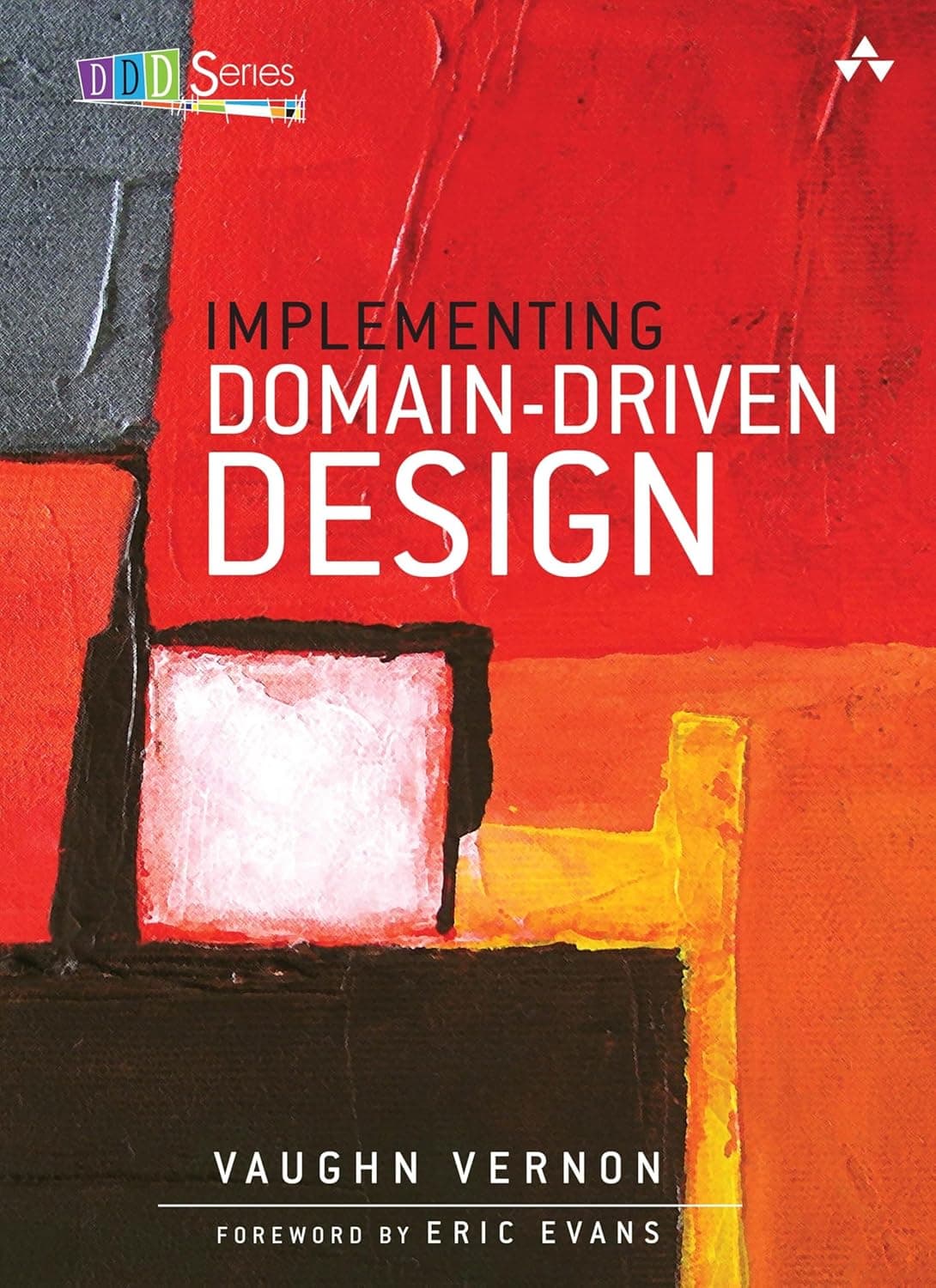
Synopsis
Implementing Domain-Driven Design takes Eric Evans's Domain-Driven Design and focuses on the tactical side: how to actually build systems using DDD. Vaughn Vernon covers bounded contexts, aggregates, entities, value objects, domain events, and repositories with concrete examples and implementation guidance.
The book walks through building a sample system using DDD, showing how to model domains, enforce invariants at aggregate boundaries, and integrate between contexts. It addresses common pitfalls—anemic domains, overly large aggregates, and misapplied patterns—and offers pragmatic advice for teams adopting DDD incrementally.
Why I Recommend It
DDD can feel abstract until you see it applied. This book bridges the gap between Evans's conceptual framework and day-to-day code. It's especially useful when you're decomposing a monolith or designing services: bounded contexts and aggregates give a disciplined way to draw boundaries and manage consistency.
Key takeaways:
- Aggregates protect invariants: Design aggregates so that consistency boundaries are explicit and small
- Ubiquitous language: The model and the language of the domain should align—code and conversation use the same terms
- Context mapping: Be explicit about how bounded contexts integrate (shared kernel, customer-supplier, etc.)
Practical application: I've used it when defining service boundaries and when refactoring legacy code toward a clearer domain model. The aggregate design guidelines help avoid "one big aggregate" or "an entity per table" extremes. The integration patterns are useful for microservices and modular monoliths alike.
Pairs well with Domain-Driven Design for the strategic side; this one is the implementation companion.
Favourite Quote
"If you don't have a clear bounded context, you don't have a clear model—you have a muddle."
Vernon emphasises that boundaries are where DDD pays off. Without them, the domain model drifts and the benefits of DDD disappear. Clarity at the boundaries is non-negotiable.